UAE VAT Guide 2026: Registration, Rates & Returns
For businesses operating in the United Arab Emirates, understanding UAE VAT is an important part of staying financially organized and tax compliant.
VAT affects much more than the amount added to an invoice. It can influence pricing, purchasing, accounting, cash flow, reporting, and the way a business maintains its financial records.
For a small company, VAT may initially seem straightforward. But as the business grows, managing hundreds of invoices, purchases, customers, suppliers, and transactions manually can become complicated.
This is why businesses increasingly rely on VAT accounting software, accounting systems, and integrated ERP solutions to manage their financial operations.
In this guide, we’ll explain the fundamentals of VAT in the UAE, including the VAT rate, registration thresholds, tax invoices, VAT returns, filing deadlines, input tax, and how businesses can simplify VAT management.
Important: VAT rules can depend on the nature of a transaction and the business’s circumstances. This article is intended as general business information, not tax or legal advice. Businesses should refer to the UAE Federal Tax Authority (FTA) and qualified tax professionals for transaction-specific advice.
What Is UAE VAT?
Value Added Tax, commonly known as VAT, is a consumption tax applied to goods and services.
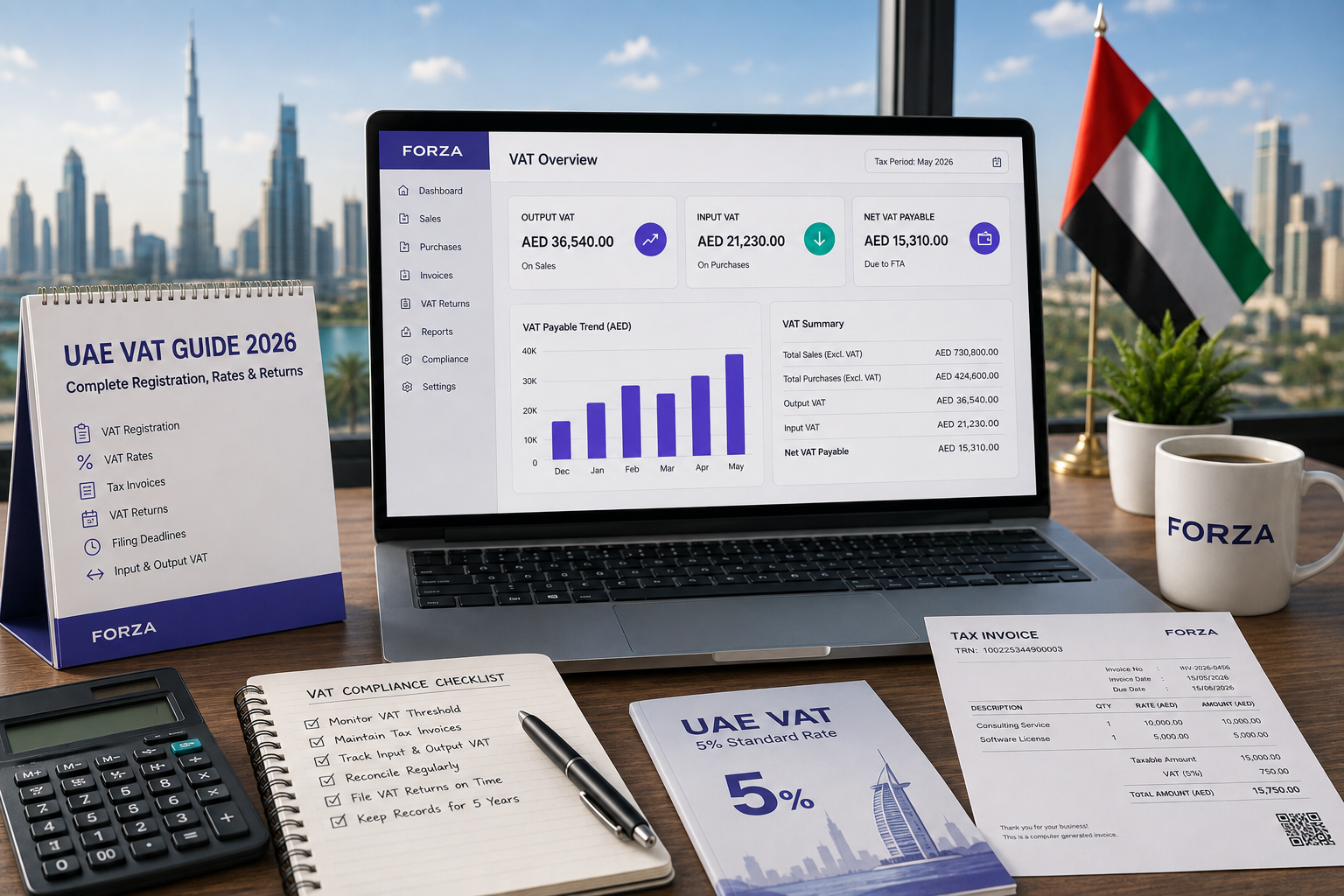
The standard VAT rate in the UAE is 5%. The FTA explains that supplies can generally fall within the standard 5% rate or a 0% rate, while certain supplies are exempt under the VAT legislation.
VAT was introduced in the UAE as part of the country’s tax framework and applies to businesses that meet the relevant registration requirements.
For businesses, VAT typically involves two important sides:
The VAT return process essentially brings these figures together so that the business can determine the amount payable to the FTA or, where applicable, the amount recoverable.
Output VAT
This is the VAT a registered business charges on taxable supplies to customers.
Input VAT
This is the VAT a registered business charges on taxable supplies to customers.
What Is the UAE VAT Rate?
The standard VAT rate in the UAE is 5%.
However, businesses should not assume that every transaction is automatically subject to 5% VAT.
Depending on the nature of the supply, a transaction may be:
- Standard-rated
- Zero-rated
- Exempt
- Outside the scope of UAE VAT in certain circumstances
The distinction matters because VAT treatment can affect invoicing, reporting, and input tax recovery.
For example, the FTA notes that taxable supplies for registration purposes can include supplies taxed at either 5% or 0%.
Therefore, businesses should establish the correct VAT treatment for their products and services instead of simply adding 5% to every transaction.
UAE VAT Registration Threshold
One of the most important questions businesses ask is:
When do I need to register for VAT in the UAE?
For UAE-resident businesses, VAT registration becomes mandatory when the total value of taxable supplies and imports exceeds AED 375,000 over the previous 12 months, or when the business expects to exceed this threshold within the next 30 days.
There is also a voluntary VAT registration threshold.
A UAE-resident business may generally apply for voluntary registration when its taxable supplies and imports, or taxable expenses, exceed AED 187,500 over the relevant period or are expected to exceed that amount within the next 30 days.
VAT Threshold UAE – Quick Overview
| Registration Type | Threshold |
|---|---|
| Mandatory VAT Registration | AED 375,000 |
| Voluntary VAT Registration | AED 187,500 |
These thresholds are important for businesses approaching growth milestones.
If your turnover is increasing rapidly, monitoring taxable supplies regularly can help you identify when VAT registration may become necessary.
How to Register for VAT in the UAE
Businesses that need to register can complete VAT registration through the UAE Federal Tax Authority’s electronic system.
The FTA’s current registration process involves creating or accessing an EmaraTax account, creating the taxable person profile, selecting VAT registration, and completing the required application.
Businesses may need supporting information such as:
- Trade licence
- Identification documents
- Business information
- Revenue information
- Supporting invoices
- Purchase orders
- Contracts
- Customs information where applicable
- Evidence supporting expected revenue
The exact documents required can vary depending on the business and application.
The FTA states that a person required to register must submit the VAT registration application within 30 days of becoming required to register.
What Is a VAT Tax Invoice?
Once a business is VAT registered, proper invoicing becomes an essential part of VAT compliance in the UAE.
A VAT tax invoice records the details of a taxable transaction and provides important information for both the supplier and customer.
A full tax invoice generally includes information such as:
- The words “Tax Invoice”
- Supplier name
- Supplier address
- Supplier TRN
- Customer information where required
- Invoice number
- Invoice date
- Supply date where different
- Description of goods or services
- Quantity
- Unit price
- VAT rate
- VAT amount
- Total amount payable
- Applicable exchange rate where relevant
These requirements are specified in the UAE VAT Executive Regulations.
Why Accurate VAT Invoices Matter
An incorrect invoice can create problems later when preparing VAT returns, reconciling accounts, or supporting input tax recovery.
For this reason, businesses should use a reliable VAT accounting system capable of generating consistent and accurate invoices.
How Does UAE VAT Return Filing Work?
VAT-registered businesses must submit VAT returns for their assigned tax periods.
The VAT return reports information relating to taxable supplies, purchases, output VAT, input VAT, and the resulting VAT position.
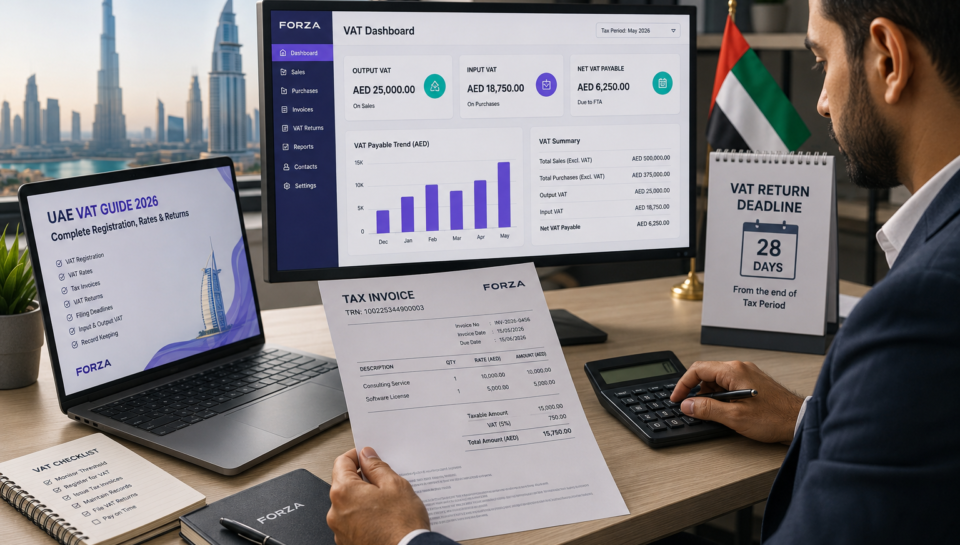
According to the FTA, VAT returns and related payments are generally due within 28 days from the end of the tax period.
Businesses should therefore avoid waiting until the deadline to organize their records.
A better approach is to maintain VAT information continuously throughout the accounting period.
Output VAT vs Input VAT
Understanding the difference between input and output VAT is essential for VAT accounting.
Output VAT
VAT charged by your business to customers.
Input VAT
VAT paid by your business on eligible purchases and expenses.
For example, imagine a VAT-registered trading company sells products worth AED 100,000 at the standard 5% VAT rate.
The VAT charged would be:
AED 100,000 × 5% = AED 5,000
If the business has eligible input VAT of AED 2,000 for the relevant period, the simplified net position would be:
Output VAT: AED 5,000
Input VAT: AED 2,000
Net VAT: AED 3,000
Actual VAT treatment can depend on the underlying transactions and applicable recovery rules, so businesses should not treat a simple calculation as a substitute for proper tax review.
What Is Included in a VAT Return?
A VAT return may involve information relating to:
.
Sales and Output VAT
The business reports taxable sales and the VAT collected from customers.
Purchases and Input VAT
The business reports eligible purchases and expenses and the associated input VAT.
Imports
Relevant import transactions may need to be accounted for according to their VAT treatment
Net VAT Position
Depending on the circumstances, the business may have VAT payable or may be eligible for a refund.
UAE VAT Accounting: Why Businesses Need Accurate Records
VAT management becomes difficult when accounting information is scattered across spreadsheets, paper invoices, emails, and different software systems.
A growing company may have:
- Hundreds of sales invoices
- Supplier invoices
- Purchase orders
- Customer payments
- Supplier payments
- Credit notes
- Expenses
- Stock transactions
- Multiple warehouses
- Multiple branches
Trying to calculate VAT manually from these records increases the risk of mistakes.
A connected VAT accounting software system can help businesses maintain a clearer audit trail.
How ERP Software Can Simplify VAT Management
This is where an ERP system can become particularly useful.
Instead of treating accounting, sales, purchasing, and inventory as completely separate processes, an ERP system connects them.
For example:
Purchase → Inventory → Sales → Invoice → Accounting → VAT Reporting
When these processes are connected, financial information can flow between departments with less manual data entry.
For trading and distribution businesses, this can be particularly valuable because sales and purchases are closely connected with inventory and warehouse operations.
VAT Management for Trading Companies
Trading companies often deal with large numbers of products, suppliers, customers, purchase transactions, and sales invoices.
Managing VAT manually can become increasingly difficult as transaction volumes increase.
A trading ERP solution can help businesses connect:
- Purchasing
- Sales
- Inventory
- Warehouses
- Customer accounts
- Supplier accounts
- Invoicing
- Accounting
- Reporting
This provides management with a more complete view of business operations.
For businesses looking for ERP software for trading companies, the goal should not simply be to calculate VAT.
The bigger objective is to maintain accurate financial and operational data throughout the entire business.
VAT and Inventory Management
VAT management is also closely connected to inventory.
Consider a distributor handling thousands of products.
Every purchase affects inventory.
Every sale affects inventory.
Every purchase and sale may also affect accounting and VAT records.
If these systems are disconnected, employees may have to enter the same information multiple times.
This creates opportunities for:
- Duplicate entries
- Incorrect VAT amounts
- Stock discrepancies
- Missing invoices
- Reporting errors
- Delayed reconciliation
An integrated ERP system can reduce this duplication by connecting inventory and accounting processes.
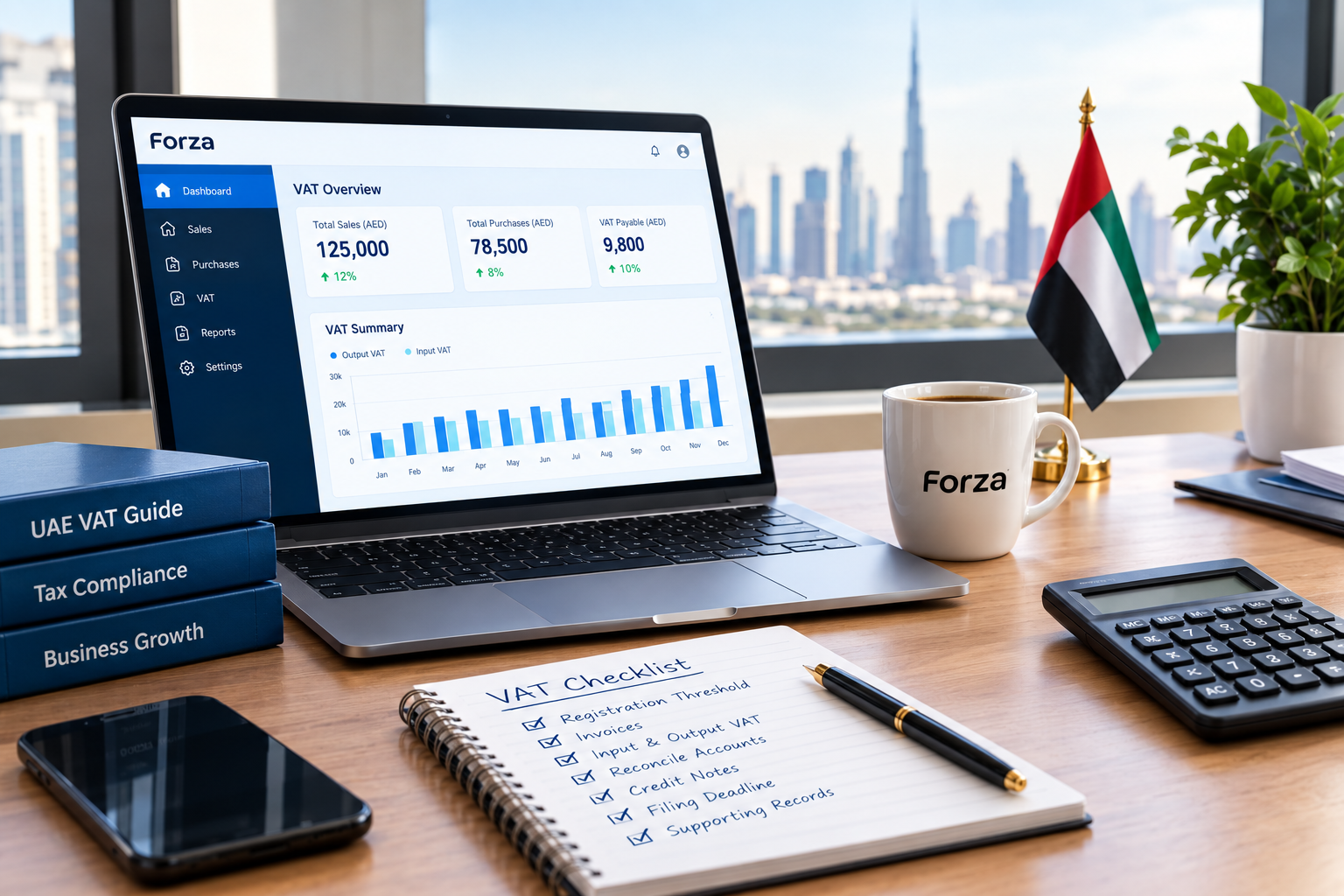
VAT Compliance Checklist for UAE Businesses
Businesses can use a simple checklist to stay organized.
1. Monitor Your VAT Threshold
Regularly review taxable supplies and imports to determine whether your business is approaching the registration threshold.
2. Maintain Accurate Invoices
Make sure invoices contain the required information.
3. Separate Input and Output VAT
Maintain clear records of VAT charged to customers and VAT incurred on eligible purchases.
4. Reconcile Accounts Regularly
Compare accounting records with invoices, bank transactions, sales, and purchases.
5. Track Credit Notes and Adjustments
VAT adjustments should be properly recorded rather than handled through informal spreadsheets.
6. Prepare Before the Filing Deadline
Do not wait until the final few days to collect invoices and calculate VAT.
7. Keep Supporting Records
Businesses should maintain appropriate records to support their VAT calculations and reporting.
The FTA’s guidance states that required records generally need to be retained for a minimum of five years after the end of the relevant tax period, subject to specific circumstances and extensions.
Common VAT Mistakes Businesses Should Avoid
Even businesses that are VAT registered can run into problems if their accounting processes are not well organized.
Manual VAT Calculations
Calculating VAT manually for large numbers of transactions increases the possibility of errors.
Incorrect Tax Rates
Not every transaction necessarily receives the same VAT treatment.
Businesses should correctly determine whether a supply is standard-rated, zero-rated, exempt, or otherwise outside the scope.
Missing Tax Invoices
Missing or incomplete documentation can make reconciliation and VAT reporting more difficult.
Poor Record Keeping
Scattered records make it harder to establish an accurate audit trail.
Late VAT Filing
VAT returns and payments should be completed by the applicable deadline.
Separating Accounting From Operations
When sales, purchasing, inventory, and accounting operate independently, reconciling VAT becomes more time-consuming.
Why Choose ERP Software for VAT Accounting?
Businesses often start with basic accounting tools and spreadsheets.
That may work when transaction volumes are small.
But as the company grows, an integrated ERP system can offer more control.
A modern ERP platform can connect:
Accounting + Sales + Purchasing + Inventory + Warehouses + Customers + Suppliers + Reporting
This means the finance team doesn’t have to rely on information from multiple disconnected systems.
For management, it also means better visibility into the financial position of the business.
How FORZA Helps Businesses Manage Accounting & VAT Data
FORZA ERP is designed to bring essential business operations together through one integrated platform.
For businesses operating in trading, distribution, retail, and other industries, FORZA can connect key processes including:
- Accounting
- Sales Management
- Purchase Management
- Inventory Management
- Warehouse Management
- Customer Management
- Supplier Management
- Reporting
- Business Intelligence
For trading companies, FORZA Trade provides a dedicated ERP solution focused on the operational needs of trading and warehouse-driven businesses.
By connecting sales, purchases, inventory, warehouses, and accounting, businesses can reduce manual processes and maintain more consistent financial information.
Explore FORZA Trade → [Internal Link]
Explore FORZA ERP → [Internal Link]
Choosing the Right VAT Accounting Software in the UAE
If you’re looking for VAT accounting software in the UAE, don’t evaluate software based only on whether it can calculate 5% VAT.
Consider the entire accounting workflow.
Ask:
- Can it generate proper tax invoices?
- Can it track input and output VAT?
- Can it integrate sales and purchases?
- Can it connect inventory with accounting?
- Can it manage multiple warehouses?
- Can it generate financial reports?
- Can it handle customer and supplier accounts?
- Can it provide real-time business information?
- Can it scale as the business grows?
The right solution should make VAT management part of your normal accounting workflow rather than a separate task performed at the end of every tax period.
Frequently Asked Questions About UAE VAT
What is the VAT rate in the UAE?
The standard VAT rate in the UAE is 5%. However, certain supplies may be zero-rated or exempt depending on the nature of the transaction and applicable UAE VAT legislation.
What is the UAE VAT registration threshold?
The mandatory VAT registration threshold for UAE-resident businesses is AED 375,000 in taxable supplies and imports over the previous 12 months or expected within the next 30 days.
What is the voluntary VAT registration threshold in the UAE?
The voluntary registration threshold is AED 187,500 for eligible UAE-resident businesses based on taxable supplies, imports, or taxable expenses under the applicable rules.
How do I register for VAT in the UAE?
VAT registration is completed through the FTA’s EmaraTax system. Businesses create or access their taxable person profile, select VAT registration, and submit the required information and supporting documents.
When is the UAE VAT return due?
The FTA states that VAT returns and related payments are generally due within 28 days from the end of the relevant tax period.
What is a VAT tax invoice?
A VAT tax invoice is a document recording the details of a taxable supply. It generally contains information such as the supplier’s TRN, invoice number, date, description, quantities, prices, VAT rate, VAT amount, and total amount payable.
What is input VAT?
Input VAT is VAT incurred by a business on eligible purchases and expenses. Whether it can be recovered depends on the applicable UAE VAT rules and the nature of the expense.
What is output VAT?
Output VAT is the VAT a registered business charges on its taxable supplies to customers.
How long should VAT records be kept in the UAE?
The FTA’s guidance states that required records generally need to be retained for at least five years after the end of the relevant tax period, subject to specific circumstances.
Can ERP software help with VAT accounting?
Yes. An ERP system can connect accounting with sales, purchasing, inventory, warehouse management, and reporting, helping businesses maintain more consistent transaction records and simplify VAT-related accounting processes.
Is VAT software useful for trading companies?
Yes. Trading companies often manage large volumes of purchases, sales, inventory, suppliers, customers, and warehouse transactions. Integrated ERP software can connect these processes and reduce the manual work involved in maintaining accounting records.
UAE VAT Compliance: The Importance of Being Prepared
VAT compliance shouldn’t be treated as a last-minute accounting task.
For a growing business, every sale, purchase, invoice, expense, and inventory transaction contributes to the overall financial picture.
The more transactions a business handles, the more important it becomes to have reliable systems for capturing and organizing that information.
A structured VAT accounting process can help businesses:
- Maintain accurate records
- Prepare VAT returns efficiently
- Reduce manual calculations
- Track invoices
- Monitor financial performance
- Improve reconciliation
- Maintain better visibility across departments
And when accounting is connected to inventory, purchasing, sales, and warehouse operations, businesses can manage their finances with much greater confidence.
Final Thoughts
Understanding UAE VAT is essential for businesses operating in the UAE.
From VAT registration and tax invoices to VAT returns, input tax, output tax, and record keeping, businesses need reliable processes to manage their tax obligations.
The 5% standard VAT rate may sound simple, but managing VAT accurately becomes more challenging as transaction volumes increase.
For growing businesses, particularly wholesalers, distributors, and trading companies, integrated ERP and VAT accounting software can help bring accounting, sales, purchasing, inventory, and warehouse operations together.
Instead of relying on spreadsheets and disconnected systems, businesses can build a more organized financial workflow with centralized data and real-time reporting.
FORZA ERP and FORZA Trade help businesses connect these essential operations through an integrated ERP platform.
Ready to Simplify Your Business Operations?
Discover how FORZA can help your business manage accounting, sales, purchasing, inventory, warehouses, and reporting from one integrated platform.